

The Courthouse Steps, My Sister's Library Card, and a Green Bottle
A retired courtroom stenographer takes down eight months of mornings with a teaspoon of Norwegian cod liver oil. Every line of the panel, the honest null trials, and the 30-day promise, entered into the record.


First, the people: Helen Marsh is a pen name. Francine, Judge Whitaker, Doris and the Thursday quilters are composites, the way courtroom stories have always worked.
Everything about the bottle, its panel, its price, its trials and its guarantee comes from the seller's own listing and published label, read in October 2026. [1]
On the second Monday of March, I sat down on the fourth step of the courthouse steps with my transcript bag on my knees, and I let the clerk go ahead of me to the parking office.
She didn't ask why I sat. She's watched me climb those sixteen steps twice a week for thirty-four years, first with a stenotype machine over my shoulder, and lately, without one.
Then she said, "Ms. Marsh, you're doing the pause again."
I didn't know I paused out loud. I knew I paused; every stenographer knows the rhythm of her own hands, and for three decades, mine kept the rhythm of the room.
But somewhere after sixty-five, the pause stopped being a breath and started being a bench.
Four steps, lean on the rail; four more, read the plaque about the 1911 cornerstone; four more, and the doors.
I'm sixty-eight. For thirty-four years I was the stenographer for the county courthouse, the woman in the corner behind the judge with the little gray machine, taking down every word at 225 words a minute.
I wrote things down for a living. I still do.
So this is a transcript. It's about sixteen courthouse steps, a sister who reads everything, a green bottle from Norway, and a teaspoon of oil that tastes of lemon.
It's also about eight months of minutes, because I don't believe anything I haven't written down.
If you've ever circled the block for a parking spot at the flat end of Main Street, you already know most of this.
Thirty-Four Years of Taking Down Other People's Words
The stenographer's chair is the best seat in the county and nobody knows it. Every argument, every verdict, every widow's will and every man fighting a fence line has passed through my machine since the spring of 1988.
You learn to hear the truth before anybody says it. The witness who answers a question you didn't ask has rehearsed.
The one who says "to be honest" five times is pricing something.
And you learn that the record doesn't care how you feel. The machine takes down the words at the speed they arrive, and it does not pause because you're tired.
That's the part I loved. For thirty-four years, my hands moved faster than my doubts.
When I retired in 2022, I kept the habit. My household minutes live in a clothbound notebook on the kitchen counter, next to the teakettle: the electric bill, the date the furnace filter got changed, the phone number of the man who fixes the porch light.
What that notebook did not hold, for two full years, was the steps.
I recorded the price of stamps to the penny and never once wrote down that I was leaning on the rail.
I'd write it down now, if I could go back. A date, a number of pauses, whether I sat; a ten-second line that would have shown me the trend a full year before the clerk did.
A transcript only tells you what somebody had the nerve to say out loud. The pauses never make it into the record.

Our courthouse steps are limestone, forty-two of them if you count the two landings, sixteen from the sidewalk to the first door. County crews re-pointed the mortar in 1998 and again in 2019.
There's nothing remarkable about them. They're the steps in about every county seat in the Midwest, and they'd become the hardest sixteen in my week.
What I Spent Before Anybody Left a Bottle
Before I tell you about the bottle, I have to enter the prior record, because a transcript that skips the beginning is a sales letter.
Here's my inventory of the two years before the green bottle arrived, with prices, the way I'd enter exhibits into the minutes.
Exhibit A-1: a heated hand-cream set from the drugstore, $19.99. My hands ached in the mornings by then, and I told myself it was the machine, twenty years after I'd stopped pushing the keys.
It lasted the winter.
Exhibit A-2: a "circulation" cream from the fair, $12. The jar promised the world in cursive.
My feet stayed cold in April.
Exhibit A-3: calcium chews from the big-box store, $22.49, two tubs. I bought them because my cousin's doctor said the word "bones" to her once.
I stopped when I remembered I don't like caramel enough to eat it daily forever.
Exhibit A-4: a walking DVD from the library sale, $3. Twenty minutes in the living room, three mornings running, and then the election coverage ate the living room.
Exhibit A-5, the expensive one: the parking spot at the flat end. $8 a month more than the lot by the courthouse, so I could walk in on the level.
That one cost money and neighbors both.
Total, from the receipts I kept: $67.50, plus a year of the flat end of Main Street.
I'm not embarrassed by the number. I'm entering it because I think half the people reading this have a similar exhibit list and have never added it up.
What I Called the Thing Before I Knew Its Name
Here's what all five exhibits had in common, and it took me a year to see it. Every one of them was aimed at something other than the thing I actually felt.
The creams were aimed at my skin. The chews were aimed at my cousin's bones.
The DVD was aimed at a living room I don't have in the morning.
None of them were aimed at the morning itself. That's what I came to call the morning pause: the heavy, low feeling in my chest when I first sat up, the few minutes of getting going that used to cost nothing and by sixty-six cost the first hour.
It's not dramatic. I want that on the record.
It doesn't send you anywhere. It doesn't even slow you down, once you're moving.
It's the standing-up part. The first flight of stairs, the first cold walk to the car, the way the second sentence of a phone call used to arrive without my having to plan for it.
And the morning pause lives in the gap, the same gap the stenographer knows. It's too small for an appointment and too stubborn for a cream.
At my last checkup, my doctor spent nine minutes with me, listened to my chest, pronounced it clear, and told me to keep walking.
He's a careful man, and he's right that nothing is wrong.
But nobody gets nine minutes of a clinic morning to talk about the pause, and I understand why. You can't bill for it.
So the pause sits there, in the record but not in the minutes.
My Sister Reads Everything Twice
Francine is my younger sister. She's sixty-four, retired from the county law library, and she reads everything twice and believes about a third of it, which is the correct ratio for a librarian.
Francine had noticed the pauses long before I said a word. She rode with me to the consignment shop on a Saturday in March, and when I parked at the flat end of Main, she looked out the window at the courthouse two blocks up and said nothing at all.
She said it in the parking lot, holding her library tote. "Helen.
You used to park at the courthouse."
I told her what everybody tells her. I'm sixty-eight, Francine.
It's the years.
She looked at me the way she looks at a misfiled opinion.
Then she said it slow, the way you dictate for the record: "The years explain it. They don't require you to schedule around it."
That sentence went home with me and sat on the counter for six weeks before it did anything.
On the first of April, I came in from the porch and found a box on my kitchen table. Green bottle, yellow cap, a little taller than a salt shaker, with mountains and sky on the label and a picture of a lemon.
Inside the box, on top, Francine had tucked one of her library due-date cards, the plain manila kind, and written on the line in her librarian printing: "Check out the label before you laugh."
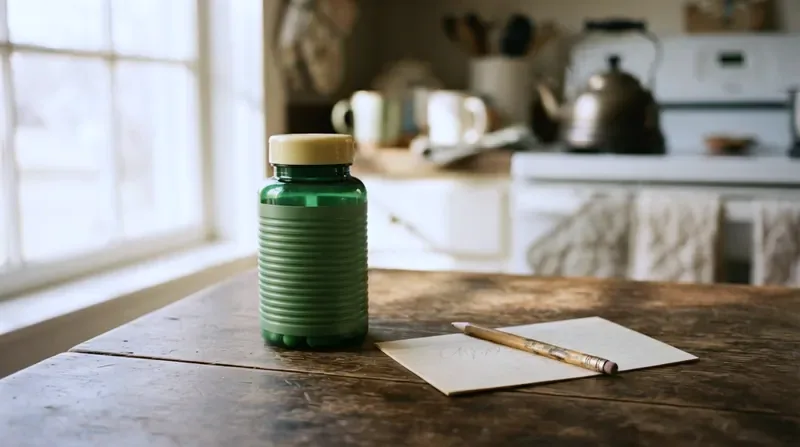
So I did the Helen thing. I read the label before I touched the bottle, the way I read a deposition before I file it.
The front of the bottle said, in plain print: cod liver oil. Wild Norwegian.
Natural lemon flavor.
And below the mountains: 1,100 mg of omega-3s, plus vitamins A and D3.
I've sworn in a thousand witnesses. When the label leads with what's in the bottle instead of what it promises, that's a witness I'll hear out.
Thirty-four Years of Hearing Claims Cross-Examined
I want to explain why I read labels the way I do, because it's the whole reason this transcript exists.
A courtroom teaches you exactly one transferable skill: you can hear a claim and, within a sentence, know who's exaggerating.
The insurance man who says "total loss" about a dented tailgate. The contractor whose invoice says "as discussed" about a discussion that never happened.
For thirty-four years I took down the testimony of experts, and the honest ones all testify the same way. They say what a thing does, they say what it doesn't do, and they don't raise their voice about either.
The supplement aisle, I'm sorry to report, testifies like the insurance man.
Everything is total loss and total restoration, in the same breath, at the same volume.
So when a bottle arrives with mountains on the label, a family company's name printed plain, and a supplement panel that lists every milligram, I notice the quiet.
I called Francine that night. "The label reads like a witness who's been prepped by an honest lawyer."
She said, "I know. That's why I left it.
Also, it's lemon, so you'll actually take it."
Why Our Grandmothers Kept a Bottle by the Flour
There's one more piece of context I want to enter before the panel, and it's the one that made me willing to try the spoon at all.
Cod liver oil isn't a new arrival being sold to me by a person my grandson's age. It's one of the oldest things on the shelf, and I can prove it with a family exhibit.
My grandmother Agnes raised four children through the leanest years of the 1930s on a farm outside Carrollton. There is a photograph from about 1936, the one we pass around at reunions, of the kitchen: wood stove, oilcloth, a hand pump at the sink.
And on the shelf, between the flour tin and the baking soda, a dark bottle with a paper label. My mother could name everything in that photograph, every apron and every cousin, and when she got to the bottle she'd say, "That's the cod liver oil.
Saturdays."
Saturdays. Not when anybody was ill.
Saturdays, the way you wound the clock.
I asked Francine, the family's librarian, what she knew about it, and she came back with the file: cod liver oil was given to children across northern Europe and North America for generations, long before vitamins had names, because families watched winters and drew their own conclusions.
The scientists caught up in the 1920s, when they found the oil carried vitamin D — the thing northern sunlight was short on from October to April. The bottles stayed on the shelves through the lean years and the war because the habit had already been running for two generations by then.
I'm not entering this as evidence that the spoon works. The family exhibit never proves the point; it only shows the witness has been testifying for ninety years without changing the story.
What it does for me is answer the question the drugstore aisle can't: what kind of thing is this? It's a kitchen-shelf thing.
It's a Saturday thing. It's not a launch, and it's not a discovery, and it will not be gone by spring.
When Gail's review crossed my desk — the one about the oatmeal — I recognized the shelf, the bottle and the decade, and I wrote the margin note "same shelf" before I'd finished reading it.

Reading the Label Into the Record
Let me read the panel the way I'd read an exhibit into the minutes: slowly, out loud, nothing skipped. [2]
Serving size: one teaspoon, five milliliters. Not two. Not a capful and a hope.
One level teaspoon, and the bottle holds fifty of them.
Calories: 40. Total fat: 4.5 grams. It's oil; a teaspoon of oil is a teaspoon of oil, and this one counts honestly.
Norwegian cod liver oil: 4.6 grams. That's the whole base of the serving. Not a blend of seventeen ocean things; cod liver oil, from wild Arctic cod caught off Norway.
Total omega-3 fatty acids: 1,100 milligrams, reported as triglycerides. Hold that phrase "as triglycerides" — I'll come back to it, because it matters more than it sounds.
**DHA, 500 milligrams. EPA, 370 milligrams.
DPA, 50 milligrams.** Those three add up to the 1,100. Each one named, each one counted, the way a ledger should be.
Vitamin A: 255 micrograms, 28 percent of the Daily Value. Vitamin D: 10 micrograms — 400 international units — half the Daily Value. Vitamin E: 6.7 milligrams, 45 percent.
Other ingredients: natural lemon flavor, natural mixed tocopherols. That's it. Two other ingredients, both of which I can picture.
Contains fish, namely cod. Printed plain, where an allergy would look for it.
When I finished reading it to Francine over the phone, she said, "Notice what's not on the panel."
I looked again. No proprietary blend. No "complex." No ingredient hiding behind a trademark.
Thirty-four years of transcripts, and the clean ones all look like this: short sentences, real numbers, nothing in the margins.
What a Stenographer's Hands Knew About DHA
Now the mechanism, and I'll do it the way the expert witnesses did it: plainly, with the limits stated.
Omega-3s are the long-chain fats of oily fish. There are two your body can't build for itself and has to take in: DHA and EPA.
The third on the panel, DPA, rides along in fish oils in smaller amounts.
DHA is the one that got my attention, for a reason a stenographer understands. DHA is a building block of nerve-cell membranes, the wiring your hands and eyes run on. It's found in high amounts in the retina, which is why the label mentions vision.
EPA is the quiet sibling, a precursor of signaling molecules. The label mentions heart function, because the two of them together are what the heart studies are about.
Here's the part I had to unlearn. I'd spent two years thinking of fish oil as "something for joints," the way the drugstore shelf talks about it. The panel reads differently. The panel is a fat, printed with milligrams, the same way flour is printed on a bread label.
And the phrase "reported as triglycerides" is the honest small print. It means the oil keeps the natural form it had in the fish, rather than being re-arranged into the synthetic form some cheaper oils use.
I'm told the natural form is what the body has been meeting in fish dinners for ten thousand years. That's a sentence I can picture, so I'll keep it.
The vitamins I'll log quickly, the way a clerk logs the exhibits already agreed. Vitamin A and vitamin D are the reasons cod liver oil exists at all — they're what the cod's liver stores, and they're why our grandmothers' generation knew this bottle by sight. The D3 at 400 IU is half your day's value in a teaspoon; the A is under a third of the Daily Value, which matters because A is a vitamin you can overdo, and this panel doesn't. [2]
One more line for the record, because it's the one nobody reads. The panel's omega-3s carry a dagger, not a percent. The Daily Value for omega-3s is not established, so no honest label can print "100 percent of your omega-3s." This one prints the milligrams and stops.
That's the kind of restraint I spent thirty-four years listening for.
What the Big Trials Actually Said
Now the part of the transcript a sales letter would skip, and the reason I trust the rest of this one.
Francine, the librarian, printed out the studies for me before she left the bottle. "You'll want the contrary exhibits," she said, and she was right, because there are contrary exhibits.
The big trials of omega-3s in healthy older people are, mostly, null. I'll read them into the record plainly, because I'd rather you hear it from me than be surprised later.
A Cochrane review — that's the organization courts trust to collect every trial on a question — pulled together three trials in over 3,500 people aged sixty and older. Omega-3 supplements made no difference to memory scores over two to three years. [3]
An eighteen-month trial of 390 adults aged sixty-five to ninety took 2.3 grams a day of DHA-rich fish oil — double what my teaspoon holds — and found no benefit on thinking scores, and a small negative on one speed test. [4]
The big three-year trial in 2,157 adults over seventy gave them 1 gram of omega-3s a day and found no benefit on a screening score, blood pressure, physical performance, infections or fractures. [5]
If you're keeping score at home, that's three null exhibits in a row, and I'm entering all three, because a transcript that hides the nulls is advocacy, not minutes.
Now the other side of the ledger, stated just as carefully. A 2015 pooled analysis of trials in adults with mild memory complaints found that DHA, alone or with EPA, was associated with better episodic memory — the remembering of events — at doses above one gram a day. [6]
And a 2018 review of fifty-one trials concluded the question is still open rather than closed. [7]
So here's my summary as the officer of the court who took down the testimony. If anyone tells you a teaspoon of fish oil will fix a memory, the record says no. If they tell you it's been studied to death and does nothing for anybody, the record doesn't say that either.
What the record supports is the modest version: these are the two fats your nerves and heart are built from, most of us eat less fish than our grandmothers did, and a panel that prints 870 milligrams of DHA plus EPA is a plain, countable way to meet them. [6] [3]
I take the modest version. At my age I've learned that the modest version is the only one that holds up on appeal.
Who Makes It, and Can You Find Them
There's a question every juror asks about every expert, and it's the right question: who pays you, and where do you live.
I ask it of every bottle now, the way I asked it of every surveyor who ever testified about a fence line. So I looked the company up, and I'm entering what I found. [8]
Carlson Labs started in 1965, in a small Chicago apartment, with a pharmacist named Susan Carlson making vitamin E for her own father. The company is still family-owned and run by her two daughters.
They'll tell you they helped start the North American fish-oil market in the early 1980s, importing from Norway, and that in 2017 they opened their own plant in Søvik, Norway, where the oil is refined, distilled and bottled. [8]
The cod is wild-caught off the Norwegian coast, and — this is the line I liked — the fish are processed the same day they're caught, and the oil is nitrogen-flushed to push the oxygen out, because oxygen is what makes oil go stale. [1]
The panel's freshness is tested by an independent laboratory, and the bottle carries two certifications I looked up: IFOS, which is the fish-oil purity testing program, and IGEN, for non-GMO. [1]
And the answer to the juror's question: the company prints its street address, 100 Schelter Road, Lincolnshire, Illinois, and a phone number, 1-888-234-5656, right in the footer of every page. [1]
Thirty-four years, and I have never once seen a supplement seller print a street address. I've also rarely seen one founded by a woman pharmacist in 1965, when the courtroom itself wouldn't have sworn her onto a hospital board.
That's not evidence that the oil works. Let me be clear about that, for the record.
It's evidence of who's accountable for it, which is a different thing, and a thing a court cares about.

What Roy Behind the Counter Said
There's one more witness I wanted to hear before I committed to the second bottle, and that's Roy Kimura, who has kept the pharmacy on Main Street since 1981 and has watched the whole supplement aisle get built around his register.
I brought the green bottle in on a Tuesday, set it on the counter between the cough drops and the crossword books, and asked him for his honest read, the same way I asked him about the calcium chews two years ago.
He read the panel the way I read a contract: slow, twice, finger on the line. Then he turned it over and read the back, which is where most people stop.
"Cod liver oil I've been selling since I started," he said. "This panel's cleaner than most.
The omega-3s are printed, the vitamins are printed, and the amounts are moderate. I've seen A panels three times this."
Then he said the thing pharmacists always say, and I'm entering it because he'd be insulted if I softened it. "It's a food, Helen, not a pharmacy. But it's an honest food, and your doctor should know you're taking it, especially with the fish-oil amount if you take anything for thinning."
I told him I already had the December appointment. He said, "Then you're ahead of most of my counter."
I asked him the question Doris sent me with: why do so many fish-oil panels hide behind "omega complex"? He shrugged the way he shrugs at candy packaging.
"Because a blend is cheaper than a number. When they print the number, you can compare.
When they print a complex, you can't."
"When they print the number, you can compare." That's the whole reason this transcript reads a panel out loud, sentence by sentence, in a world that would rather you didn't.
One Teaspoon, at Breakfast, With Food
The label's own direction is the shortest sentence in the case file: one teaspoon daily, at mealtime. [2]
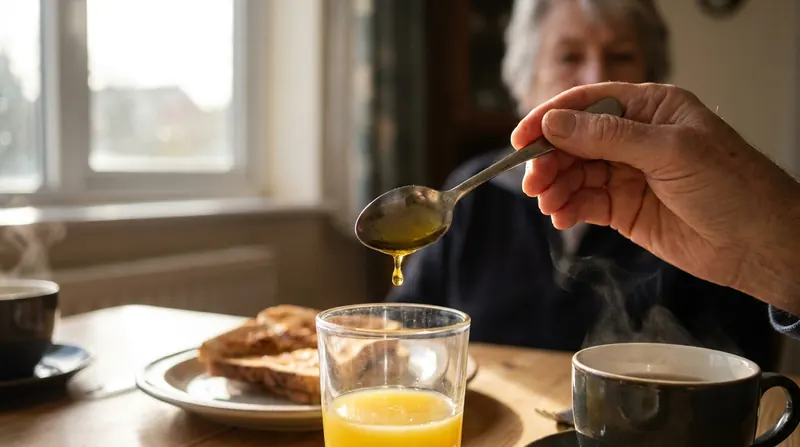
I take mine at breakfast, which is when Francine takes hers. The teaspoon goes into the bottle, comes out gold, and goes into a small juice glass.
It reads like a teaspoon of warm lemon honey, if honey were thin.
The taste, since everyone asks and the record should show it: lemon, honestly. Not lemon candy, not furniture polish; lemon the way the rind smells when you zest it. There's a second underneath, faintly, of the sea — the first morning I noticed it, and by the second week I had to look for it. [8]
The label says to refrigerate after opening and to use the bottle within 100 days. Fifty servings, 100 days; the arithmetic is a spoon every other day, or a spoon a day with a pause halfway.
I do the spoon a day and let the second bottle start when it starts.
That's the whole ritual. No schedule, no counting past one, nothing to mix. A teaspoon rides along on a breakfast that was already happening.
I want to say that plainly, because it's the reason I'm still taking it in October when the walking DVD is in a drawer. In thirty-four years I watched a hundred habits get adopted in January and dropped by the equinox, and the survivors were always the ones that rode in on something the person was already doing.
The cream had to be remembered. The chews had to be wanted. The teaspoon just has to be at the breakfast table, which it now is, next to the salt.
What the Teaspoon Is, and What It Isn't
Any witness who's been on the stand long enough learns to state the negatives before the cross-examination gets there. So let me enter the negatives myself, plainly, in one place.
It is not a capsule. There's nothing wrong with capsules; I took a calcium capsule for a while in my fifties and swallowed it fine. But a liquid spoonful is a different proposition: you can see it, you can smell it, you know exactly how much left the bottle, and there is no gelatin shell standing between you and the arithmetic.
It is not a meal or a medicine. Forty calories, four and a half grams of fat, a teaspoon at breakfast. It doesn't replace the fish on your plate, the walk in your morning, or the appointment on your calendar, and the label's own small print says as much: the statements on the bottle have not been evaluated by the Food and Drug Administration, and the bottle makes no claim on any condition. [9]
It is not fast. The minutes took three weeks to show me a margin note worth circling and six to show me the courthouse doors without the rail. Anyone promising a body like mine overnight has never taken testimony from one.
It is not for everyone, and the bottle says so. It contains fish — cod, printed on the panel, where a fish allergy would need it. If you take anything daily, especially anything that affects bleeding — and fish oils in large amounts can — the question goes to your own clinic before the first spoon, not after. The label dose is one teaspoon; the caution lines in the guides talk about three grams a day and up, which is nearly three times this panel. [2]
And it is not a promise about anybody's memory, including mine. I've entered the null trials above, and I'll stand by them at any reading of this record. [4] [3] [5]
A stenographer learns that a witness who states his own limits is a witness you can quote. This bottle states its limits in six-point type on the side of a green label, and I've read them into the record anyway.
What I Wrote Down, Week by Week
I started the minutes on Monday, April 6. I'd like to say I started out of hope, but the record should show I started out of stubbornness, because Francine was going to ask.
I kept the minutes the way I kept the court minutes: a line a day, pencil, the date first. Where I paused on the courthouse steps, how long I leaned, whether the morning pause showed up when I sat up, and the weather, because the weather is always a factor in the record.
Helen's morning minutes, April to June
- Week 1Paused at the rail on the second landing every walk, 30 to 40 seconds. Morning pause unchanged. The spoon tastes of lemon and I keep waiting to mind it.
- Week 2Same rail, same pauses. One margin note: "stood through the whole church announcement without shifting weight." Thought little of it at the time.
- Week 3The middle flight went quiet. Walked past the plaque about the 1911 cornerstone without reading it, which I've done every Monday for two years.
- Week 4Paused at the rail twice out of six walks instead of six out of six. The morning pause is shorter. Not gone. Shorter.
- Week 6Courthouse doors and back without the rail, twice in a row, at my pace. Doris from the clerk's office said "You're early" and I was.
- Week 8Francine walked it with me. "You're talking the whole way up." I was; I was telling her about the Søvik plant in Norway like I'd been there.
I want to slow down on week two, because that margin note is the one I'd circle if this were a deposition. Stood through the whole church announcement without shifting weight.
For two years I had shifted from foot to foot through anything longer than a hymn, quietly, the way you do, thinking nobody could see a woman rocking gently in the third pew.
In week two, I stopped. I only noticed because my knees stopped complaining, which is the only way a body files its reports.
Week three is where the minutes really changed. Not the top of the steps, which is still the top of the steps, but the middle flight, where I used to start planning my lean.
I walked through it one Tuesday thinking about a library budget, and when I looked up I was at the doors.
Week six, I made the doors and back without the rail, twice running, at my pace, not a young woman's pace. The record should show I'm sixty-eight and the steps don't care what I used to do.
And week eight, Francine walked up beside me and said the thing I've already entered: I was talking the whole way up. Sixteen steps, two sentences about a fish plant in Norway, no planning, no pause.
That's not a trial result. It's a pencil line in a clothbound notebook, written by a woman who wanted to prove her sister wrong and couldn't.

The Entry I Didn't Want to Write
The minutes have more pages now, and I'm adding one that doesn't flatter the bottle, because minutes that only climb shouldn't be trusted.
The second week of August, the humidity sat on this county like a wet wool coat. Ninety-one degrees by ten in the morning, and the air felt wringable.
I paused at the rail twice that week. I wrote both pauses down without embarrassment, because a record only works if it's honest, and I swore to that record the way I swore to the court.
But here's the difference eight months makes. Before, the pauses owned the schedule: I planned errands around them and mapped the town by its benches.
Now the pauses are weather. They come on the worst days, they go, and the rail has gone back to being a rail.
That's the most honest sentence in this transcript. The spoon didn't make me forty; it made the steps steps again, instead of a verdict.
And one more entry for completeness, because Francine will read this. The 500 mL bottle is cheaper per spoon, and I bought one in September, and it's too tall for my refrigerator door shelf, so it lies down on the middle shelf like a small green log.
First-world minutes, but the record is the record.
What I'll Do When the Cold Comes Back
I'm writing the last of these minutes on a morning with frost on the kitchen window, and a transcript that only reports the warm months is a transcript with a page missing.
Every winter of my adult life, the same arithmetic has arrived with the first hard freeze. The morning pause lengthens.
The steps get steeper without changing grade. The parking lot at the historical society gets longer.
Last February, before the green bottle, I parked at the flat end for eleven straight days and told Doris the lot by the courthouse was "icy." It was not icy.
I checked the minutes.
So here is the winter plan, entered while the frost is still on the glass, so you can hold me to it in January.
The spoon stays at breakfast. Refrigerated, as the label says; cold oil pours slower and the lemon goes quieter, but the arithmetic doesn't change.
The walk stays at eight. Cold mornings, the courthouse steps, my pace. I may pause at the rail in January and I'll write it down if I do, because a minute book that only records spring is a brochure.
The appointments stay first. My yearly checkup is in December, and I'll take the panel with me, the way I'd take a deposition summary. My doctor gets the exhibit before the bottle gets another season.
The needle stays threaded. Thursday quilting moves to afternoons when the mornings go gray, and the historical society meets the second Monday, and I intend to stand through every report about the 1911 cornerstone all winter.
That's the whole plan. It's not much of a plan, and that's the point — it's the plan I can actually keep, which is the only kind I've ever seen survive January.
Ask me in March how it went. The minute book will say.

What Other People Say, In Their Own Words
I'm one woman with one notebook. So I went looking for what other people said about the same bottle, and I'm only entering what the seller publishes on its own product page, word for word, under its own review widget. [8]
The product page shows 214 reviews on this exact listing. I can't verify each reviewer and neither can you; what I can do is copy the words exactly, the way I'd read back a transcript.

The impeccable quality of Carlson products speaks for itself. The cod liver oil is an excellent addition to my health goals. Two teaspoons contain an exceptional amount of combined EPA and DHA,and the naturally occurring vitamins A and D provide extra support for bone health. The lemon flavor is quite good.

Taste is very mild lemon and no fishy taste. Very good.

I love this product. The taste is truly OK, considering that it's Cod Liver Oil, but you get used to it. I remember my mother giving this to me when I was little, right along with the oatmeal. (I didn't like that either, but I ate both) Mom took all her life. Mom was smart. Her wisdom lives in me now.
Read Gail's twice. "I remember my mother giving this to me when I was little, right along with the oatmeal."
That review is a small history lesson, and it's the one Francine taped inside her kitchen cabinet. Our grandmother kept a bottle of cod liver oil on the same shelf as the flour, in a kitchen with no refrigerator for the first ten years of it, and Gail's mother and ours were doing the same arithmetic in the same decade.
Tom's is the shortest testimony I've ever entered, and the kind I trust most: seven words on the taste and nothing promised.
And I'll note for the record what the widget also shows: the review topics buyers themselves tag most are smell, feel, quality, shipping, skin, oil, benefits and taste. People writing about a fish oil mostly argue about flavor, which tells you the conversation is where it should be — on the spoon, not on a marvel.
These are the seller's own published reviews, so they're its best foot forward. Hold them the way you'd hold any testimony: real people, real words, individual experiences, not a promise for anyone else.
What the Thursday Quilters Asked
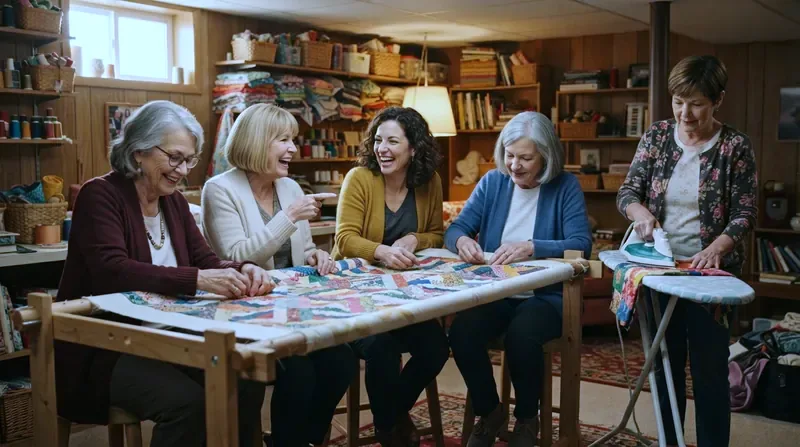
On Thursday afternoons, five of us quilt in Doris Halloway's basement, and after the short version of these minutes circulated at the fabric store, the quilters convened their own hearing.
Here are their questions and the answers I gave, as close to verbatim as my notes allow, because a quilter remembers your exact words longer than a judge does.
Doris: "Does it taste like the 1960s?"
It does not. The 1960s tasted like a dock at low tide. This tastes like lemon zest with a distant memory of the sea. [8]
Pat, who quilts with a fan on her even in January: "Why not just eat fish?"
You should, if you like it and can afford it twice a week. I like it and I can't. The teaspoon is the fish I don't cook, at 870 milligrams of DHA plus EPA, printed. [2]
Ellen: "Isn't cod liver oil the thing with too much vitamin A?"
That was the old concern, and it's a fair one; A is a vitamin you can overdo. This panel prints 255 micrograms, 28 percent of the Daily Value, well under the adult ceiling of 3,000. I read that line twice before the first spoon, and I'd tell anyone to do the same, especially if you take anything daily already. [2]
Ruthanne, the youngest at fifty-nine: "Is it a habit forever?"
Fifty servings, one bottle, thirty days to send it back. Nothing about it is forever, which is the only reason I agreed to try it.
Doris again, on her way to the ironing board: "Would you have bought it if Francine hadn't left it?"
I'm on my fifth bottle, Doris, and Francine only paid for the first one.
Four Spoons, One Thursday, a Glass of Water Each
Because the quilters would not let the flavor question rest — and because Francine claims the lemon is "barely there" and I claim it's "right there" — we conducted the only properly documented taste trial in the history of Doris Halloway's basement.
The protocol, which I wrote on an index card and taped to the frame: one teaspoon each, in two ounces of room-temperature water, no looking at each other's faces, verdicts written before discussion.
I'll read the verdicts into the record exactly as written, spelling and all.
Doris: "Lemon soap, but the polite kind. I'd take it on Sundays."
Pat: "Like the lemon in a fish house, which I mean as a compliment and I know how that sounds."
Ellen: "Better than the one my mother gave us, which I can say now that she can't hear me."
Ruthanne, fifty-nine, the control group of one: "Honestly? Fine. You're all being dramatic."
Mine: "Lemon zest, a low tide underneath by week two, and nothing I'd schedule around."
Then we discussed, which is to say Doris and Pat argued about fish houses for ten minutes while Ellen quilted and Ruthanne ate the shortbread.
The upshot, entered without enthusiasm from two parties: four of five would take it daily, one would take it Sundays, and zero of five said the word "ick," which for a spoon of fish oil is a verdict the bottle should frame.
For the record, the seller sells four flavors — lemon, green apple, fruit splash and natural — and I have tasted only the lemon, because the lemon is the one Francine left and I am a one-bottle woman. [1]
Natural, for the record, is the flavor my grandmother's generation took, and they deserve every honor the county can organize. I am not that strong.
I take the lemon.
What Readers Filed When the Short Version Ran
A shorter version of these minutes ran as a letter in September. The comments were better than the letter, which is usually how it goes.
The comments below are illustrative and retold with names shortened. They're filed here because they ask what you're probably asking.
Bernice's comment is the one I keep returning to. A green bottle on a shelf next to the baking soda, and a daughter who never asked why.
Our mothers didn't explain the bottle because nobody explained the bottle; it was furniture, like the flour. We're the first generation that asked it to testify, and the panel holds up better than I expected.
And Carol's is the one I'd underline for anyone reading. The steps we save add up to a smaller town, one avoided hill at a time.
I know exactly what the flat end of Main Street costs, because I paid it for a year.
Two That Came by Mail, on Paper
The short version of these minutes brought two letters through the actual mailbox, which at my age is still how you know you've been read. Both writers said I could print them.
They're letters, not reviews: nobody in them has tried the bottle, and I'm filing them for that reason exactly.
Helen — Your grandmother Agnes was my Sunday school teacher in 1951 and I will tell you what she told us about the spoon, because you clearly inherited her notebook if not her stove: "We are not doing this because we are sick. We are doing this because winter is coming and we intend to be well." I have walked to your courthouse twice this month to see the 1911 cornerstone and I parked at the top. You may enter that.
Alberta walked to the cornerstone, parked at the top, and put me in my place, all in one stamp. I read it to Francine on the phone and she said, "Agnes was pre-deposition conditioning in a kitchen apron," and she's not wrong.
Retired county road inspector. I clocked your sixteen steps against my own hill out of professional habit and yours is steeper by a percentage I won't put in print. I'll say what I tell the young engineers: the grade isn't the verdict, the drainage is. Whatever keeps things moving in the morning is worth more than anything that promises to level the road. Keep the minutes.
"The grade isn't the verdict, the drainage is." A road inspector and a stenographer, two counties apart, both describing the same morning with our own trades.
I wrote him back that his letter was entered as a friend-of-the-court brief, and he'll know exactly what I meant, because his county has a courthouse with steps too.
Helen and Francine, on Tape
In August, Francine came over to quilt and stayed for coffee, and I turned on the recorder app, the way I do when I want the minutes to have voices.
Two retired sisters, one kitchen table, one green bottle. Here's what we said, cleaned up only where the teakettle drowned us out.
The Marsh Sisters · Thursday Kitchen Tape
Helen and Francine Take the Label Apart
 Helen
host
You left a bottle on my table in April and a library card that said "check out the label before you laugh." So you're going to sit there while I read you the panel and you explain yourself.
 Francine
guest
Gladly. Read it the way you read everything, slowly, and I'll tell you which lines I underlined before I wrapped it.
Helen
host
Total omega-3s, 1,100 milligrams, as triglycerides. DHA 500, EPA 370, DPA 50. That was the line you underlined, wasn't it.
Francine
guest
Twice. Because "as triglycerides" means it's the fat in the shape the fish wore it, and because every number is right there. Thirty-four years of court reporting and you know what a clean ledger looks like. That's a clean ledger.
Helen
host
Now the line I underlined, and you're not going to like it. Vitamin A, 255 micrograms, 28 percent. You know I asked Doris about that, because Doris remembers the warnings from the eighties.
Francine
guest
I underlined it too, for the opposite reason. The ceiling for grown-ups is 3,000 micrograms; the teaspoon is a twelfth of the ceiling. A panel that prints a number you can check against a limit is a panel that isn't hiding.
Helen
host
What sold you, honestly? Because you read the null studies before you bought your own bottle, I know you did.
Francine
guest
I did, and that's what sold me. The big memory trials in healthy old people are null, and this company doesn't claim them. The heart societies want fish twice a week, and I eat fish twice a month if the church has a fish fry. The teaspoon is the arithmetic between those two sentences.
Helen
host
Say the null part again for the tape, because people will ask.
Francine
guest
Three big trials, no memory benefit from fish oil in healthy people our age. That's the record and I'll sign it. What the record also has is a pooled analysis where over a gram a day of DHA plus EPA tracked with episodic memory in people who'd complained of it. Modest, in the right people, honestly stated. I'm a librarian, Helen; I'll take modest and stated over loud and invented.
Helen
host
The company prints a street address in Illinois and a phone number in the footer. You know what that means to me.
Francine
guest
It means if the bottle disappoints you, you can find them, which is more than the fair-cream man ever offered. Family company since 1965, a woman pharmacist who started it, and a plant they own in Norway. Accountability is my love language.
Helen
host
And if it does nothing for me?
Francine
guest
Then you send the unused part back within thirty days and they refund the bottle price, and you're out the shipping and a walk to the post office. That's the whole downside, printed on their policy page. I read it twice, it's what I do.
Helen
host
One more for the record. Did you know I paused on the courthouse steps?
Francine
guest
Helen. The whole east side of Main Street knew. The clerk timed you like a rail crossing. I just happened to be the sister with library access to the research and a birthday coming.
Helen
host
The minutes say one pause at the second landing now, down from four and a lean. I wrote it with three question marks the first week.
Francine
guest
And now you write it without any, which is the only statistic either of us actually owns. Keep the minutes, keep the appointments, and let the bottle testify for itself.
Francine started her own bottle in May, the 500 mL, which she stands upright in the door shelf because her refrigerator was built after the war.
She walks the reservoir loop on Tuesdays and Fridays, same as ever. The difference, she says, is that she now talks the whole way around, and has stopped pretending it's the company.

Where the Teaspoon Fits in an Ordinary Day
People ask what my day looks like now, as if there were some regimen taped to the icebox. There isn't, and that's the point of these minutes.
6:20 a.m. The kettle goes on. I sit up, take inventory the way I used to check the machine ribbon, and the morning pause either shows or doesn't.
Most mornings now it's a shrug. Humid ones, it's a paragraph, and I write it either way.
6:30 a.m. Toast, marmalade, the small glass. The spoon goes into the green bottle, comes out gold, goes into the glass, and down.
Six seconds, maybe seven if I'm reading the paper while I do it.
6:45 a.m. The minute book. Yesterday's line, today's date, the weather.
Then the crossword, which I do in pen now, out of spite.
8:00 a.m. The walk. Down the porch steps, up Main Street to the courthouse, sixteen steps to the doors, around the 1911 cornerstone plaque, and home the long way past the fabric store.
The rest of the day has nothing to do with any bottle. I quilt on Thursdays, I take my sister to the nursery on Saturdays, and I watch the evening news with the sound of gavel-free living.
That's why I trust the teaspoon, honestly. A thing that asks six seconds of a breakfast that was already happening is a thing you'll still be doing in October.
The walking DVD asked for twenty minutes and a cleared living room. It lasted three mornings and became a trivet.
The cream asked to be remembered twice a day. It lasted a winter.
The teaspoon asks to sit next to the salt. It's lasted eight months and counting, and the bottle count is five.

Where the Label Stands, Line by Line
Here's the summary I'd file at the end of the transcript. If you only remember one page of these minutes, make it this one.
✓ Every milligram printed: 1,100 mg of omega-3s as triglycerides — DHA 500, EPA 370, DPA 50 — plus A, D and E at honest fractions of the Daily Value. No blends, no trademarks. [2]
✓ A company you can find: family-owned since 1965, its own Norwegian plant, an Illinois street address and a phone number in the footer. [1] [8]
✓ Independent testing for freshness, potency and purity, plus IFOS and IGEN certification, printed on the page, not implied. [1]
✓ A 30-day money-back guarantee: return the unused part within 30 days of delivery for a refund of the bottle price. [1]
✓ Reviews that argue about flavor, not faith: 214 on the listing, with lemon winning. [8]
✗ The big memory trials are null. Three trials, thousands of healthy older adults, no benefit to thinking scores from fish oil. Anyone who tells you otherwise is not reading the record. [4] [3] [5]
✗ It won't make sixty-eight feel like thirty. The steps are still steps; this is support for the climb, not a cable car.
✗ The refund excludes shipping and takes a walk to the post office. Thirty days from delivery, not from when you finish the bottle. Keep the order email.
If You're Standing at Your Own Rail
I can't tell you what to do; I took down verdicts for thirty-four years and I know exactly how little the person in the corner gets to say.
I can tell you what I'd do if I were reading these minutes instead of writing them, back in March, at the flat end of Main Street.
First, before you buy anything at all: tomorrow morning, walk your own sixteen steps, whatever they are — the porch, the church steps, the far end of the parking lot — and notice where you pause.
Second: write it down. One line, a pencil, the date and the place.
That line costs nothing, and in eight weeks it's the only witness you'll have.
Third: if the pause frightens you instead of annoying you — pressure, a chest that feels wrong, a change that came on fast — that's a same-week appointment, not a bottle. I say that as the woman who transcribed enough malpractice testimony to know the difference.
And fourth, if the clinic has heard you and the morning pause is still sitting there: read the panel I've entered above. One teaspoon at breakfast, 1,100 milligrams printed as plain as a court exhibit, fifty servings, thirty days to change your mind.
I'm not going to pretend a link on a reading page is anything but a door to the seller's shop. The Senior Scribe doesn't keep inventory; we keep minutes.
But if you walk through that door, you'll know exactly what's on the other side: a lemon spoonful, a family company with a street address, the null trials read into the record, and thirty days.
I'm not saying the $67.50 was wasted because the spoon is cheaper. I'm saying the $67.50 was aimed at my skin and my cousin's bones, and the $0.91 is aimed at the morning.
And one arithmetic note for the record, because a stenographer checks the addition: the 500 mL bottle works out to about $0.66 a morning. I stay with the 250 because it fits the shelf, and Francine buys the 500 because she stands it up anyway.
$45.50 for 50 servings · One lemon teaspoon at breakfast · 30 days to decide
Ordering, Shipping, and the Small Print
Since the minutes started running, I've ordered from the seller four times, and I want to enter the plain logistics, because a transcript that ends at the promise skips the part where the promise actually ships.
The order. The listing lets you buy one bottle or set up a subscription, and the subscription takes fifteen percent off, which brings a 250 mL to $38.68. The subscription also pauses, skips or cancels whenever you like, which I tested in September out of pure stenographer suspicion, and it paused.
I buy one bottle at a time. Not because the subscription is a trap — pausing worked — but because I'm sixty-eight and my history with standing orders is the fruit-of-the-month club of 1997, and I don't sign up for things twice in one lifetime.
The shipping. The seller ships free over thirty-five dollars, and a single bottle clears it. My orders arrived in four days, five days, three days and four days, in a padded mailer, with the bottle sealed and the cap taped.
The oil arrives cold-weather-gold and thick in January and pours faster in July. That's what an oil does; the nitrogen flush inside the bottle keeps the air off it until the cap comes off, and after that the label says 100 days. [1]
The packaging note. The company says the line is 100 percent plastic-neutral — they fund the removal of as much plastic from waterways as their bottles add — and the bottle is recyclable. I'm entering it because they print it, not because I've audited it; I'm a stenographer, not an accountant. [8]
The one complaint I can file. The 500 mL does not fit a standard refrigerator door shelf. I've mentioned it.
Somebody in Lincolnshire should draw a door shelf.
That's the whole logistics exhibit. Four orders, four arrivals, one pause that paused, one shelf that doesn't fit. Small print that survives contact with an actual customer is the rarest testimony in the aisle.

Short Answers to the Questions Doris Gets
The fabric store still asks questions faster than I can answer them at the counter, so here's the read-back, the way we close the record.
Short answers, read back before you go
How do you take it?
One teaspoon, five milliliters, once a day at mealtime, per the label. Mine goes in a small glass at breakfast.
What does it taste like?
Lemon zest with a distant memory of the sea. By the second week I had to look for the sea. [8]
How long does a bottle last?
Fifty servings at one teaspoon a day; the label says to use it within 100 days of opening, so one bottle lasts most people about seven weeks at one spoon a day.
What's the guarantee?
Thirty days from delivery, money back on the unused part, excluding shipping; you start it by email at [email protected]. [1]
Why not just eat fish?
You should, if you do it twice a week. I don't, and the teaspoon is the arithmetic I actually keep.
What about the vitamin A I've heard about?
The panel prints 255 micrograms, 28 percent of the Daily Value, against an adult ceiling of 3,000. If you take anything daily or you're pregnant or nursing, show the label to your own clinic first. [2]
Will it fix my memory?
The big trials in healthy older people say no, and I've entered them above. I take it for the modest version: the two fats the nerves and heart are built from, printed plain. [3] [5]
The plain summary, entered and read back
The seller prints every milligram of the panel, tests it for freshness, potency and purity, and puts a street address and a phone number under its own name: 100 Schelter Road, Lincolnshire, Illinois, 1-888-234-5656, with [email protected] for returns.
The 30-day money-back guarantee stands on the policy page: unused portion back within 30 days of delivery, full refund of the bottle price, shipping excepted.
The rest of us still get listened to by our own clinic first, and that order doesn't change.
250 mL · One lemon teaspoon at breakfast · 30-day money-back guarantee
One more line, and then I'll let you get to your own morning. The minute book is on the counter, next to the green bottle and the salt.
This morning's line reads: "Oct 23. Courthouse and back for the historical society meeting.
Talked with the clerk about the 1911 cornerstone for the whole middle flight. No rail."
No rail. Two words, in pencil, written by a woman who used to lean and read the plaque twice a week like it was assigned reading.
P.S. Francine's library card is still tucked in the box lid, "Check out the label before you laugh," and I've checked it eight times now, which is the longest any book has stayed checked out in her professional memory; if your own steps have started keeping minutes, the seller's page answers most questions and the thirty-day policy answers the rest.
P.P.S. Remember the fourth step, where I sat in March with the transcript bag on my knees; I stood on it for the whole historical society report on Monday, on purpose, and nobody in the room noticed but me, which is exactly how the record should read.
The full ingredient guide, with notes on omega-3s, DHA and EPA, and on reading supplement advertising, is linked at the foot of this page.